




High yield strength and tensile plasticity are crucial for the engineering applications of metallic materials. Currently, only a few ultra-high-strength steels achieve a bulk yield strength (σy) of 2 GPa. However, they lack sufficient work hardening capacity during plastic deformation, resulting in the uniform deformation reported in standard uniaxial tensile tests being composed of serrated plastic flow caused by localized deformation bands, rather than true uniform elongation (ɛu). These ultra-high-strength steels, such as maraging steels, typically have very low uniform elongation (e.g., ɛu ~ 5%). Although the classic second-phase strengthening mechanism can effectively improve the yield strength of materials, the strengthening level is limited by the low volume fraction of the second phase in the alloy (often < 50 vol.%), leading to a sharp decrease in tensile plasticity. Therefore, designing alloys with both a yield strength σy ~ 2 GPa and a uniform elongation ɛu significantly higher than 10% is a major challenge in materials science.
In response to the above challenges, Professor Zhang Jinyu, Professor Ma En, and Academician Sun Jun from the National Key Laboratory of Metal Material Strength at Xi'an Jiaotong University proposed the use of ultra-high volume fraction intermetallic compound precipitates, namely coherent L12 nano phase and non coherent low modulus hard plastic B2 micro phase, to couple and strengthen the FCC rich iron complex alloy matrix based on their previous achievements (Acta Mater, 2022, 233: 117981; Scripta Mater, 2023, 222: 115058). In order to achieve ultra-high strength and large uniform tensile ductility at room temperature, the design concept of this alloy is: i) to increase its strength with a high volume fraction of coherent L12 nano phase with high inversion domain boundary energy, and ii) to introduce a high volume fraction of low modulus non coherent B2 micro phase; On the one hand, non coherent interfaces are more effective in hindering dislocation motion and improving yield strength than coherent interfaces. On the other hand, the introduction of multiple alloying elements reduces the anti phase domain boundary of B2 to increase its plasticity, allowing these particles to act as dislocation storage units and improve work hardening ability.
The design concept of multi principal element alloys results in a huge compositional selection space for complex alloys, which poses unprecedented difficulties for designing high-performance alloys based on traditional "trial and error" methods. To this end, the team members conducted component screening using domain knowledge assisted machine learning methods. The most significant element Ta (rather than element Ti) synergistic alloying was achieved through the high solid solubility light element Al and L12 opposite phase domain boundaries, resulting in the L12+B2 dual precipitation phase strengthened Fe35Ni29Co21Al12Ta3 (at.%) complex alloy (Figure 1). The volume fractions of L12 nano phase (rich in Al, Ta) and B2 micro phase (rich in Al, poor in Ta) were as high as~67 vol.% and~15 vol.%, respectively. Both the coherent L12/FCC interface and the non coherent B2/FCC interface were able to strongly interact with dislocations (Figure 2). Not only can it generate dislocations, but it can also store dislocations, especially the low modulus B2 micron phase can be compared to (FCC+L12) The higher density of dislocations stored in the matrix (Figure 3) significantly enhances the work hardening performance of the alloy, thereby improving its yield/tensile strength and tensile ductility, enabling the alloy to achieve an unprecedented strength plasticity combination at room temperature, significantly better than all reported alloys to date (Figure 4). The alloy design strategy proposed by the team also provides new ideas for the design of other high-performance alloys.
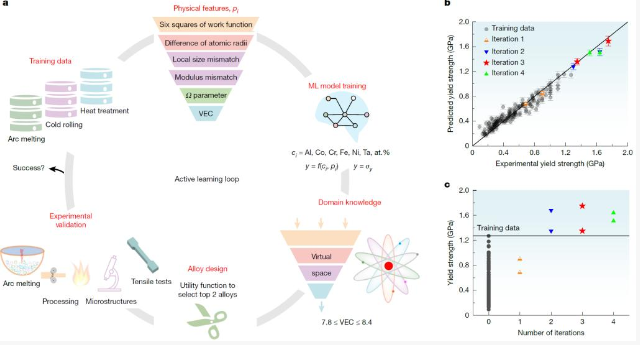
Figure 1. (a) A domain knowledge based machine learning model (consisting of six active learning cycles) predicts the FeNiCoAlTa complex alloy with super plasticity. (b) The theoretical predicted yield strength is consistent with the experimentally measured yield strength, confirming the reliability of the machine learning model. (c) The relationship between experimentally measured yield strength and the number of model iterations reveals the optimal composition of Fe35Ni29Co21Al12Ta3 complex alloy.
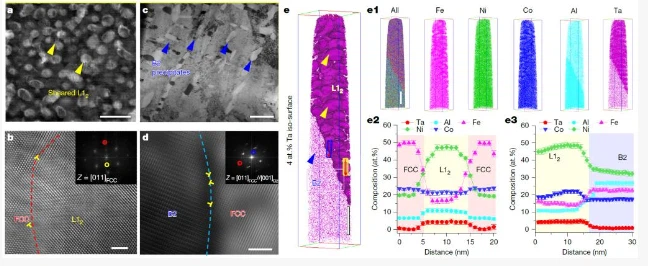
Figure 2. (a-d) Room temperature deformation and interface characteristics of Fe35Ni29Co21Al12Ta3 complex alloy with three-phase structure, i.e. dislocations can cut through L12 nano phase and store in low modulus B2 micro phase. Dislocations exist at both L12/FCC coherent and B2/FCC non coherent interfaces; (e) Atomic probe analysis of the chemical composition and distribution characteristics of complex alloys, as well as the elemental composition of multi principal L12 nano phase and B2 micro phase.
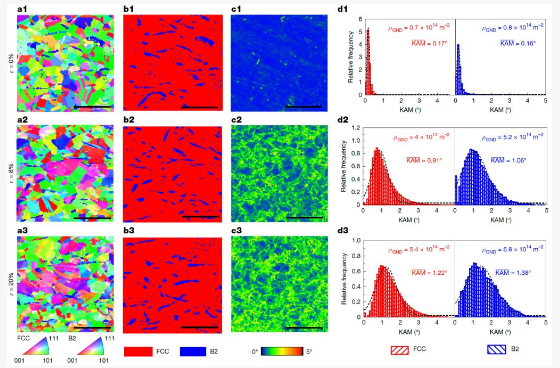
Figure 3. Evolution of dislocation density of each constituent phase in Fe35Ni29Co21Al12Ta3 complex alloy with strain (a1-d1) ε=0, (a2-d2) ε=8%, and (a3-d3) ε=20%, indicating that the low modulus B2 micron phase can store higher density of dislocations than the (FCC+L12) matrix.
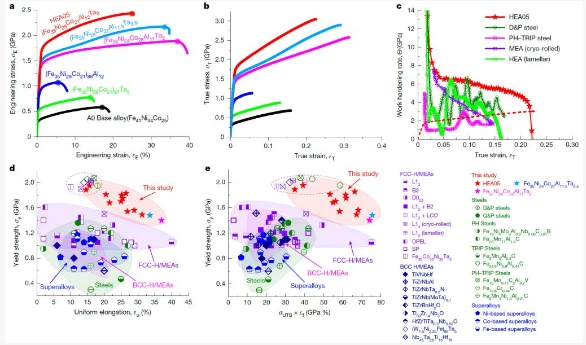
Figure 4. (a-b) Engineering stress-strain and true stress-strain curves of complex alloys with different compositions, (c) Comparison of work hardening performance of Fe35Ni29Co21Al12Ta3 complex alloy with other 2GPa grade ultra-high strength metal materials (D&P steel, martensitic steel, medium high entropy alloys), and (d, e) Comparison of yield strength uniform tensile elongation matching and yield strength strong plastic product matching of Fe35Ni29Co21Al12Ta3 complex alloy with other metal materials. The combination of mechanical properties at room temperature is significantly superior to other reported metal materials.
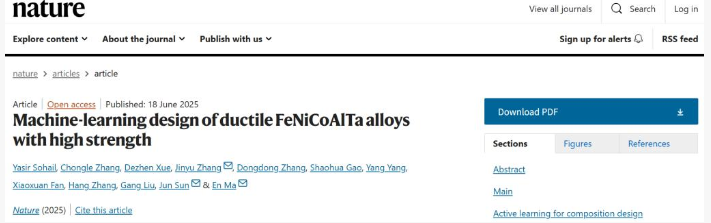
The research findings were published online in Nature under the title "Machine learning design of ductile FeNiCoAlTa alloys with high strength". Yasir Sohail and Zhang Chongle, doctoral students from the School of Materials Science and Engineering at Xi'an Jiaotong University, are the first and second authors of the paper, respectively. Professors Zhang Jinyu, Marx, and Academician Sun Jun are co corresponding authors of the paper. Professors Liu Gang, Xue Dezhen, Associate Professor Yang Yang, and doctoral students Zhang Dongdong, Gao Shaohua, Fan Xiaoxuan, and Zhang Hang also participated in the work. The National Key Laboratory of Metal Material Strength at Xi'an Jiaotong University is the only communication and completion unit for this work. This job is the first time that foreign students from the School of Materials Science at Xi'an Jiaotong University have published a Nature article as the first author. This work has received funding from the National Natural Science Foundation of China, the 111 Talent Introduction Base, the Shaanxi Provincial Science and Technology Innovation Team Project, and the Central University Basic Research Business Fund. The characterization and testing work has received strong support from the Analysis and Testing Shared Center of Xi'an Jiaotong University, the Experimental Technology Center of the School of Materials Science, and Shanghai Light Source.


