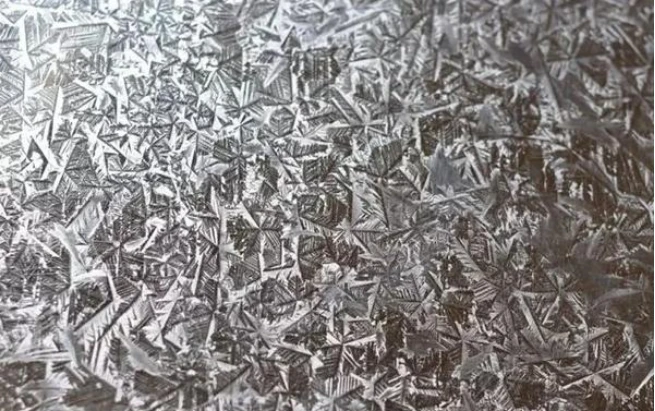
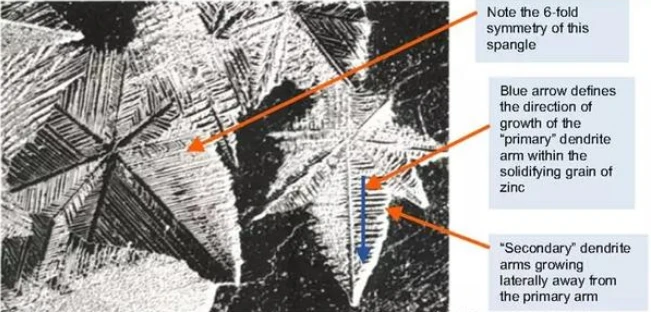
Having beautiful zinc flowers is a major feature of traditional hot-dip galvanizing and sheet metal. The most complete form of zinc crystals is similar to snowflakes or hexagonal stars, so zinc crystals obtained by condensation on the surface of hot-dip strip steel are most likely to form snowflakes or hexagonal star shaped zinc flowers.
High purity zinc liquid cannot solidify and form zinc flowers during cooling because it lacks the necessary crystal nuclei. To obtain typical zinc flowers, the prerequisite is to add two types of alloy elements with different properties in an appropriate amount to the zinc solution. One type of alloy element is completely soluble in the zinc solution but almost completely insoluble in solid zinc, such as lead and titanium; Another type of alloying element has a certain solubility in both liquid and solid zinc, such as aluminum, tin, antimony, etc. If only a certain type of alloying element is added, although the surface state of the zinc layer will change after solidification, it is not enough to form typical zinc flowers.
The method of forming zinc flowers
The method of forming zinc flowers is to try to generate a large number of crystal nuclei early, reduce the solid temperature of zinc solution, and prolong the growth time of zinc flower crystals, which facilitates the growth of zinc flowers.
(1) . Adding other elements to zinc waves
When a certain alloying element is added to the zinc solution, its crystallization process can be prolonged, and the surface zinc solution will not solidify until it reaches its eutectic temperature+.
Pure zinc solidifies at 419.5 ° C. If tin (less than 0.5%) is added, the tin zinc eutectoid alloy will not solidify before it reaches 198 ° C. If cadmium is added, the cadmium zinc eutectoid alloy will not solidify before it reaches 264 ° C. If antimony (below 0.3%) is added, the antimony zinc eutectoid alloy will not solidify until it reaches 409 ℃. After adding lead, the lead zinc eutectic alloy will not solidify until it reaches 317 ℃.
Therefore, adding alloys to lower the melting point of zinc liquid can prolong the solidification time to varying degrees compared to pure zinc, greatly extending the growth time of zinc flower crystals and facilitating the growth of zinc flowers. Therefore, larger zinc flowers can be obtained.
(2). Surface blowing gas method
When the surface zinc layer is about to solidify, if steam or sulfur dioxide flows through its surface to allow the zinc flower crystals to grow smoothly, larger patterns can be obtained. Another purpose of blowing sulfur dioxide gas is to form a dense oxide film and improve the corrosion resistance of the galvanized layer.
(3). Wire mesh method
This method can only be used on galvanized thin sheets, which is achieved by using magnetic rollers to bring the steel wire mesh into contact with the surface of the zinc layer. Due to the cooling at the contact point of the steel wire mesh joints, solid particles of crystallization are first generated at this point, forming crystal nuclei. The remaining un solidified zinc liquid starts to crystallize and expand outward, forming zinc flowers.
(4). Spray mist method
Spray water mist (a mixture of water and steam or water and air) on the surface of galvanized steel parts before the pure zinc liquid solidifies, causing crystal nuclei. The uncured zinc liquid starts from this point and diffuses outward to form zinc flowers.
(5). Other methods
In addition to the above methods, if the surface of the plated part can be smooth, the galvanized layer can be relatively thin, the temperature can be controlled to decrease uniformly, and there is sufficient air cooling time, a larger zinc flower can also be obtained.