Applying various coatings to the surface of products is one of the most important surface treatment processes. It not only makes the products look good but also serves to protect the product substrate.
Among these, powder coating and painting are two widely used spraying processes. Many people may not understand the difference between them, and some even believe that they are just different names for the same process. However, in reality, they are two distinct processes, utilizing different equipment and following different process flows.
Actually, whether it's powder coating or painting, they both belong to the category of spraying. By understanding powder coating and painting separately, you can know the difference between them.
spray painting
Paint spraying is a simple and widely used surface treatment process. It involves placing paint in a container, pressurizing it with machinery, and spraying the paint onto the product in a mist form to form a layer of paint film. Paint spraying is widely used in fields such as ships, locomotives, bridges, and machinery.
The primary function of painting is to protect products or semi-finished products from rust and corrosion. Additionally, it serves a decorative purpose, enhancing the aesthetic appearance of the products.

Classification and characteristics of painting
Based on the operation method, painting can be divided into manual painting and automatic painting.
Manual painting involves a worker holding a spray gun and spraying paint onto the product according to the shape of the workpiece.
The advantages include flexible and convenient operation, adaptability to products of different environments, shapes, and sizes, simple equipment, and low energy consumption;
The disadvantages include low production efficiency, unstable spraying quality, high labor intensity for workers, susceptibility to paint mist pollution, and poor working conditions.
Automatic painting involves using a mechanically operated spray gun to apply paint to products.
The advantages are high productivity, stable spraying quality, and good working conditions for workers.
The disadvantage is that the equipment is relatively expensive and the equipment structure is complex.

Paint spraying can also be divided into two types: air spraying and high-pressure airless spraying.
Air painting uses a spray gun as a tool, relying on the compressed airflow to disperse and atomize the paint, which is then sprayed onto the surface of the product to form a paint film.
Air spray painting has advantages such as simple equipment and dense coatings; however, it also presents disadvantages, including the generation of a large amount of paint mist during the spraying process, which pollutes the air and results in significant paint loss. Moisture and other impurities in the compressed air can easily mix with the paint stream, which, if not properly treated, can affect the quality of the coating.
Air spray painting is widely used for manual painting of large areas and complex workpiece shapes. Due to the generation of a large amount of paint mist during the painting process, measures are taken to limit the environmental pollution caused by paint mist.

High-pressure airless spray painting utilizes a high-pressure pump within a sealed container to pressurize the paint, which is then sprayed out from a spray gun. Due to the sudden pressure drop, the paint immediately expands violently and atomizes, spraying onto the surface of the workpiece to form a paint film.
High-pressure airless spray painting boasts advantages such as high productivity, minimal paint mist, reduced air pollution, improved working conditions, and strong paint film adhesion. Additionally, due to the absence of impurities like water and oil in the paint flow, the protective performance of the coating is also excellent. However, high-pressure airless spray painting also has disadvantages, including a more complex equipment structure, less uniform coating compared to air spray painting, and poorer decorative properties.
High-pressure airless spray painting is suitable for painting small products. To improve hygiene conditions, it is advisable to conduct high-pressure airless spray painting operations in a spray booth.

Painting process flow
Before painting, the product must also undergo treatment to clean its surface through methods such as rust removal and degreasing. Only in this way will the paint layer be more secure.
After processing, the product needs to undergo surface cleaning. Once it has been naturally dried, it is ready for painting.
Painting can be done by spraying a single coat of paint directly, or by repeating the process 2-3 times to achieve a dense and sturdy paint layer. The first coat of paint is also referred to as a primer, which needs to be sanded before the next coat is applied.

powder coating
Compared to painting, powder coating is a more complex process. It involves using equipment to directly spray powdered paint onto products, serving both protective and decorative purposes. Powder coating is often referred to as electrostatic powder coating.
Spray painting is a widely used metal surface treatment technology, which is extensively applied in various fields such as hardware, home decoration, and building materials.

Principle of powder coating
During the powder coating process, powder coating material contained in a container is delivered to the nozzle via compressed air. At the tip of the nozzle, high-voltage static electricity is generated, forming an electrostatic field.
When the paint powder passes through this electrostatic field, it will discharge electricity to each particle, eventually turning each powder particle into charged paint ions. Under the influence of electrostatic forces, when sprayed out, these ions will be attracted by products with opposite polarity, thereby adsorbing onto the surface of the product.
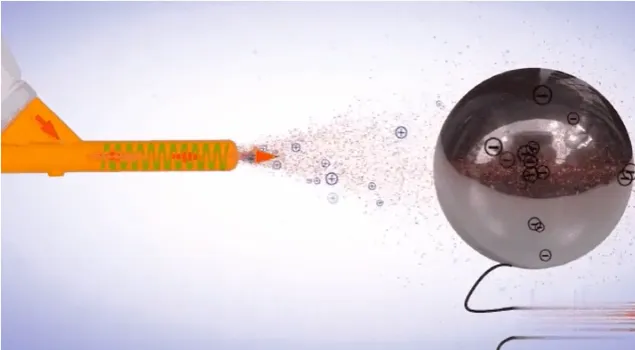
As the coating powder accumulates more and more, the charge will also accumulate more. When it reaches a certain thickness, the charged powder will be repelled by the charged powder already covering the product, and the coating powder will no longer continue to accumulate.
Characteristics of spray painting
Spray painting can directly use coating powder, which eliminates the need for dilution with liquid and causes less harm to the environment and human body.
The coating quality achieved after employing this electrostatic spraying technique is excellent, with strong adhesion; it also requires relatively low technical skills from workers, has a short curing time, and avoids many drawbacks such as liquid sagging.
However, spray painting also has disadvantages such as being difficult to repair on the surface and high cost.
Process flow of powder coating
Like other surface treatment processes, products also need to be treated before powder coating, ensuring the surface is clean before the coating process.
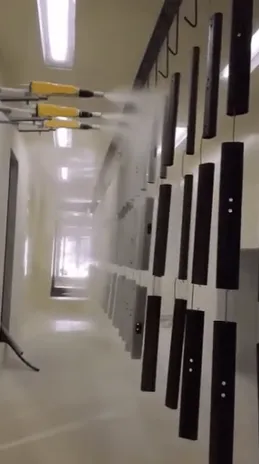
The spray painting process involves directly spraying paint powder onto the product, but the adhesion at this stage is not very strong. Therefore, an important step is required, which is high-temperature curing.
By placing the product sprayed with paint into an oven at a certain temperature, the paint powder will melt and self-level under the influence of high heat. Finally, after curing, a dense and sturdy spray-painted layer will be formed.
The difference between painting and powder coating
By introducing powder coating and painting separately, we can understand the differences between them.
The leveling of paint is better than that of powder coating, because the molecular structure of additives and solvents used in painting aids in leveling, whereas these components are absent in powder coating.
Paint can be applied for small-area repairs, whereas powder coating cannot. Furthermore, paint exhibits better flexibility than powder coating, allowing for small-scale bending.
The decorative features of spray painting are quite diverse, with fast delivery times. It allows for customization and small-batch production.
Spraying plastic must undergo high-temperature baking, so the adhesion will be better, but there will also be requirements for product size. If it is too large, it cannot be placed in the oven. However, spray painting does not require size requirements for the product and can be applied over a large area.
Therefore, it's not possible to say who is better between painting and powder coating. The appropriate spraying process needs to be adopted based on different product requirements.