


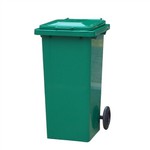
Hey there! I'm a supplier of large size outdoor trash cans, and I often get asked how to accurately measure the capacity of these big bins. It's not as straightforward as you might think, especially when dealing with different shapes and designs. In this blog, I'll share some practical methods to help you get an accurate measurement.
Why Accurate Measurement Matters
First off, why is it so important to measure the capacity of outdoor trash cans accurately? Well, if you're a business owner, you need to know how much waste your bins can hold to plan your waste collection schedule effectively. Overestimating the capacity might lead to overflowing bins, which is not only unhygienic but also a bad look for your place. On the other hand, underestimating could mean you're paying for more frequent collections than necessary.
Tools You'll Need
Before we start measuring, let's gather the tools. You'll need a measuring tape, a calculator, and some paper and pen to jot down the measurements. If the trash can has an irregular shape, you might also want to have a bucket of known volume and some water to use the displacement method, which I'll explain later.
Measuring Regular - Shaped Trash Cans
Cylindrical Trash Cans
Most large outdoor trash cans are cylindrical. To measure the capacity of a cylindrical trash can, you need to measure two things: the radius (half of the diameter) of the base and the height of the can.
Use your measuring tape to measure the diameter of the base of the trash can. Then divide this number by 2 to get the radius. Next, measure the height of the can from the bottom to the top.


The formula for the volume of a cylinder is (V=\pi r^{2}h), where (V) is the volume, (r) is the radius, (h) is the height, and (\pi) is approximately 3.14.
For example, if the diameter of the base of the trash can is 2 feet, then the radius (r = 1) foot. If the height (h) is 3 feet, then the volume (V=3.14\times1^{2}\times3 = 9.42) cubic feet.
Rectangular Trash Cans
Rectangular trash cans are also common. For these, you need to measure the length, width, and height. Use your measuring tape to measure the length of the base, the width of the base, and the height of the can.
The formula for the volume of a rectangular prism (which is what a rectangular trash can is) is (V = l\times w\times h), where (l) is the length, (w) is the width, and (h) is the height.
Suppose the length of the base is 2 feet, the width is 1.5 feet, and the height is 3 feet. Then the volume (V=2\times1.5\times3 = 9) cubic feet.
Measuring Irregular - Shaped Trash Cans
Some outdoor trash cans have unique or irregular shapes. In these cases, the displacement method can be very useful.
First, find a bucket with a known volume. For example, you might have a 5 - gallon bucket. Fill the bucket with water and carefully pour it into the trash can. Keep track of how many buckets of water you pour in until the trash can is full.
Let's say you use 3 full 5 - gallon buckets to fill the trash can. Then the capacity of the trash can is (3\times5 = 15) gallons.
Converting Measurements
You might need to convert the volume from cubic feet to gallons or vice versa. One cubic foot is approximately 7.48 gallons. So, if you measured the volume of a trash can in cubic feet and want to know the capacity in gallons, multiply the volume in cubic feet by 7.48.
For instance, if the volume of a trash can is 9.42 cubic feet, then the capacity in gallons is (9.42\times7.48\approx70.46) gallons.
Factors That Can Affect Capacity
It's important to note that the actual usable capacity of a trash can might be less than the measured volume. For example, if the trash can has a locking lid like the Outdoor Metal Trash Can with Locking Lid, the lid mechanism might take up some space inside the can. Also, if there are internal dividers, like in the 3 Compartment Stainless Steel Garbage Bin, the total capacity is divided among the compartments.
Other Considerations
When measuring the capacity, make sure to measure from the inside of the trash can. Sometimes, the outer dimensions are different from the inner ones due to the thickness of the walls.
Also, if you're dealing with a trash can that has a tapered shape (wider at the top than the bottom), you can use an average radius or length and width for a more accurate measurement.
Our Product Range
As a supplier of large size outdoor trash cans, we offer a wide variety of products to meet different needs. Whether you need a simple cylindrical can or a more complex multi - compartment bin, we've got you covered. We also have smaller options like the Small Metal Trash Can Outdoor for areas with less waste.
Contact Us for Purchase
If you're in the market for high - quality outdoor trash cans and need help with capacity selection or have any other questions, don't hesitate to reach out. We're here to assist you in finding the perfect trash can for your outdoor space. Whether it's for a park, a commercial building, or a residential area, we can provide the right solution.
References
- Basic geometry textbooks for volume formulas.
- Industry standards for waste management and trash can sizing.